

By Rickard Mårtensson
Autonomy is a new buzzword.
While many companies wish to make their fleet autonomous, they’re not always sure where to start.
While the pathway may be fuzzy, the opportunity isn’t. Autonomous operations can help address driver shortages, reduce costs, increase safety, and improve productivity by letting vehicles run nearly 24/7. Unfortunately, without a concrete roadmap, the idea of going autonomous can quickly feel overwhelming.
I’d like to share a phased, practical approach to introducing autonomy to your business, including evaluating where to begin, readiness assessments, and building a business case that delivers value and not just vision.
Define your operational design domain
The first question we often hear is: “Where do I start?”
At SteerAI, we advise organizations, regardless of their sector, to start with the concept of Operational Design Domain, which refers to a clearly defined environment or a set of conditions in which autonomous systems can operate safely and predictably. Note that it’s essential to involve your operations teams from the beginning since they hold critical insight into the daily reality that technology alone can’t solve.
Together, you can create this domain by identifying repetitive, high-volume flows within a fleet, such as internal yard logistics at a manufacturing plant. Focus on flows where the environment and conditions are stable and predictable. These offer a predictable setting and reasonably fast return on investment.
From there, narrow your scope further by identifying which flows are the easiest to automate first. Then, take stock of the equipment you already have and evaluate whether it could support these flows with some upgrades, and what adjustments might be needed to get there.
Start with real flows that solves actual operational problems, and scale to to other areas and uses cases from there. One or two testbed flows are enough to learn and refine before scaling further.
Assess readiness before going autonomous
Before you introduce a fully autonomous fleet, you need to evaluate whether your organization and systems are ready across three key dimensions: Operational, technical, and infrastructure.
Operations
Many companies overlook the fact that autonomy is about rethinking the entire operational process that supports the transition. It’s important to identify whether the flows are still manual or only partially digitized, including what happens during loading and unloading and whether that can be automated, as well as how many touchpoints still rely on human intervention.
Digitizing operational flows is a critical first step. Organizations should make sure to map them out and to identify which parts can be automated and where human input remains essential. They should also consider the knock-on effects. For instance, autonomous vehicles can run longer hours, which means that scheduling and logistics systems need to adapt, or create bottlenecks.
Technology
Regarding technical readiness, organizations need to identify whether their existing fleets can handle proposed autonomous operations. If you want to convert vehicles in your existing fleet: Are vehicles drive-by-wire? Can they be retrofitted with automation kits? What updates or equipment are needed? What’s the best path? Retrofitting, replacing, or phasing in over time?
A technical assessment takes about three months and provides a clear picture of what’s feasible.
Infrastructure
Finally, it’s important to keep in mind that going autonomous also relies on transitioning digital and physical infrastructure as well as vehicles. Organizations need to check their connectivity, such as private or public networks, to support real- time operations. Other questions include the following:
Building a business case
Once you’ve completed your readiness assessment, it’s time to make decisions. That means building a business case that justifies the investment and moves beyond one-off pilots or proof of concepts. These are impressive—but they rarely deliver long-term business value.
Remember, the decision to go autonomous often rests with chief operating officers, supply chain heads, or site managers—not just tech teams. Make sure your business case speaks their language and aligns with broader strategic goals.
To make your case, you need to quantify the benefits clearly and realistically. One autonomous vehicle on its own won’t deliver meaningful ROI, but when planned at scale, autonomy drives major impact.
In logistics, autonomy can help save on labor, improve safety, increase productivity, and offer greater scalability. In defense, it significantly reduces risk to human life, acts as a force multiplier and enhances operational resilience. In all sectors, it helps reduce repetitive or unpleasant work for humans, lowers emissions, and improves energy efficiency.
From assessment to action
Once your case is clear, the next step is implementation. Organizations can expect the complete transition to autonomy to take six to 18 months depending on scope and scale.
To ensure ownership and continuity across the project, you need to set up an internal autonomy team that brings together operations, IT, infrastructure, and leadership. Organizations should also make sure they learn from early rollouts by feeding insights from testbed flows into their broader strategy.
Going autonomous is a transformation project where organizations must completely rethink how their entire operation works. It touches everything from workflows and infrastructure to teams and business models, which is why success starts with a clear understanding of flows, an honest assessment of readiness, and a sharp focus on business value.
When you approach autonomy through this lens, it stops being a futuristic idea and starts becoming a tangible opportunity.
Rickard Mårtensson is Head of Growth at SteerAI, which delivers AI-powered autonomy for logistics and defense, transforming vehicles into autonomous solutions.
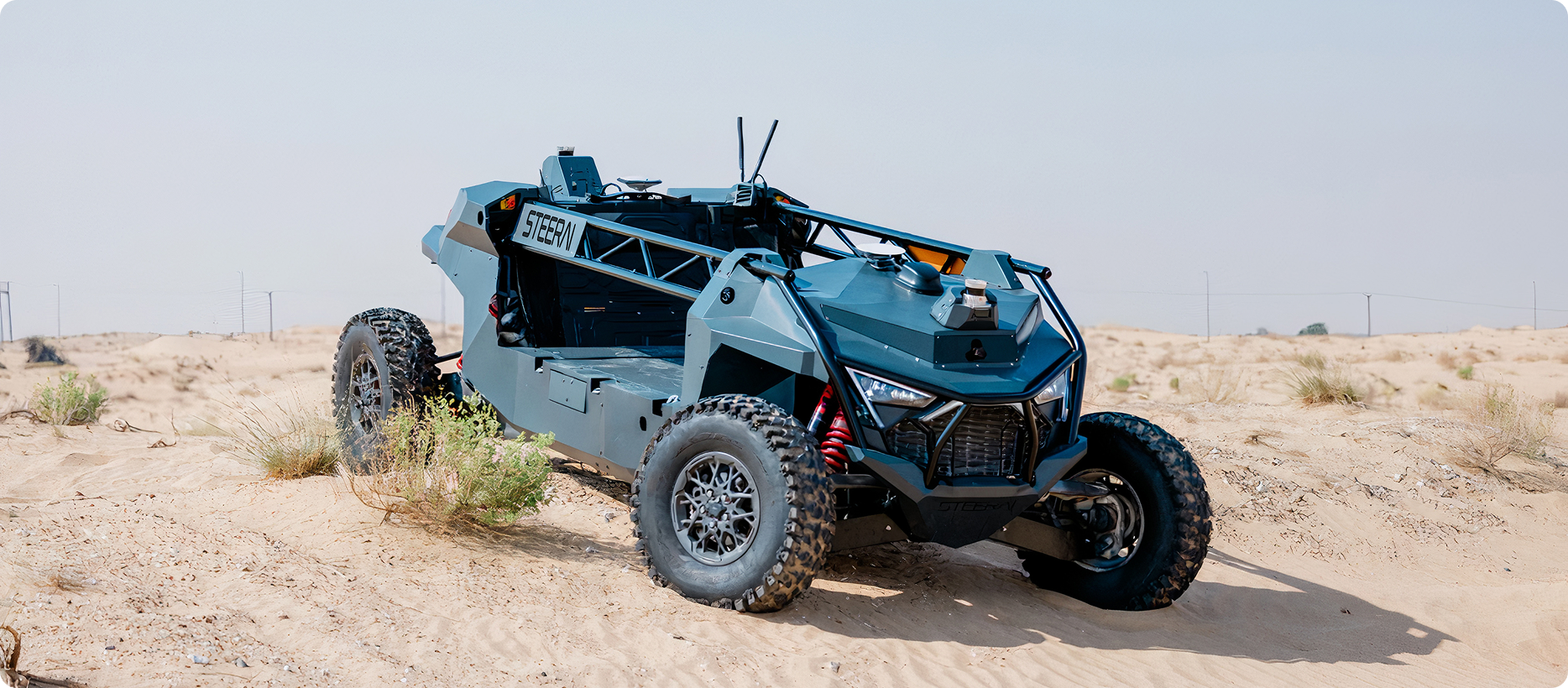
SteerAI is designed to turn standard industrial and defense vehicles into autonomous machines that can handle complex opearations.